
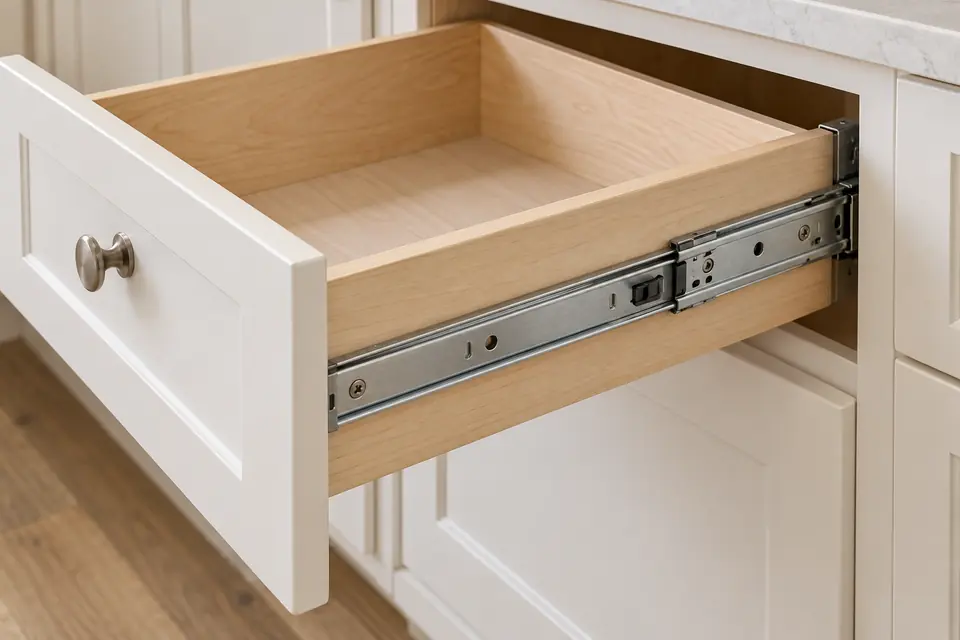
Describe the failure before choosing parts
Empty the drawer if you can do so safely, then note when the problem occurs: opening, closing or carrying weight. Identify whether the drawer front is loose, the box is separating or the runners are visibly damaged. Stop using a drawer that may fall. For a repair request, photograph the closed front, the open drawer and accessible hardware without forcing a stuck mechanism.
Match more than the nominal length
A replacement needs the correct mounting style, available clearances and compatible drawer construction. Photograph any manufacturer marking and the rear attachment. Side-mounted and concealed undermount systems do not use identical preparation. For example, Blum publishes drawer construction requirements for its TANDEM runners. Use the selected product’s instructions instead of assuming every drawer accepts the same hardware.
Compare a hardware repair with a new box
If the box and cabinet attachments are sound, a compatible hardware replacement may keep the existing appearance. Split joints, deteriorated material or unavailable parts can make a new drawer box worth discussing. Ask whether the original front can be retained, how adjacent gaps will align and whether finish work is included. Drawer repair has no approved fixed planner price; photos and parts identification come first.
Manufacturer or agency reference: Blum TANDEM product and construction details
Distinguish a runner problem from an attachment problem
Describe whether the drawer behaves differently when nearly empty, partly open or near the end of travel. A drawer that drops at one corner, catches repeatedly in one location or pulls its front away from the box gives the reviewer different information. These observations help organize inspection; they do not establish which component has failed.
Look only at hardware that is already visible during normal use. A loose rear bracket, damaged cabinet side or separated drawer joint may need repair before new slides can be secured. Replacing runners without addressing their attachment can leave the original problem unresolved. Keep a sticking drawer in place if removal requires force or an unfamiliar release, and mention anything that could fall when it is opened.
Identify the drawer as a complete assembly
For each affected drawer, record its room and position: for example, the upper drawer beside the sink. Numbering drawers avoids confusion when several fronts look identical. Photograph the front closed, the opening around it and any accessible side or underside hardware. Include manufacturer markings and a ruler beside a visible component when practical.
The front, drawer box, runners, brackets and cabinet structure work together. A face-frame cabinet can present different attachment details from a cabinet without that frame. Two neighboring drawers may use different hardware because they have different depths or loads. Group apparently identical drawers for planning, but ask the installer to verify compatibility before ordering replacement parts for the entire kitchen.
Decide what appearance should be retained
Keeping the original front is often an important part of the request because it matches surrounding cabinets. Say whether that is a priority. A replacement box behind the existing front, a compatible runner repair and a complete new drawer are separate options. Availability and the condition of the retained parts influence which option is practical.
Discuss visible gaps, front alignment and handles as part of the finished result. Changing runners will not automatically correct a damaged front or mismatched finish. If a new box is proposed, ask how it will connect to the front and whether any new work remains visible. This makes a repair comparison more useful than choosing parts only by their purchase price.
Use a sample repair when many drawers need attention
For a kitchen with widespread problems, one representative drawer can reveal construction and sourcing issues before a larger order. Choose a sample that reflects the group being repaired; the largest pot drawer may not represent narrow utensil drawers. Confirm whether the sample assessment, parts ordering and later installation are separate visits.
Keep the remaining drawers in the inventory even if they are deferred. Mark which are unsafe to use, which bind occasionally and which are simply candidates for an upgrade. This lets VPS separate urgent restoration of normal operation from optional improvements. A proposed soft-close conversion should still receive its own compatibility review rather than being treated as the default replacement for every broken slide.
Agree on a practical completion check
Ask the quote to state the number of drawers, retained fronts, replacement components and any box or cabinet repairs. Identify whether contents must be cleared beforehand and whether finish touch-ups are included. Parts lead time can affect scheduling, especially where the existing system is discontinued.
At completion, review alignment, travel and closing behavior with the installer using the intended ordinary contents and the selected system's instructions. Do not overload a drawer as a test. Keep product details for future repairs and note any adjacent drawer that remains outside the agreed scope. If handles are also changing, the cabinet hardware installation guide helps separate that visible work from the runner and box repair.